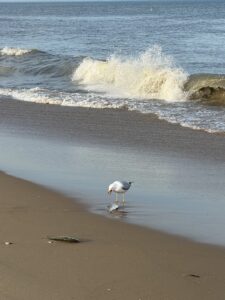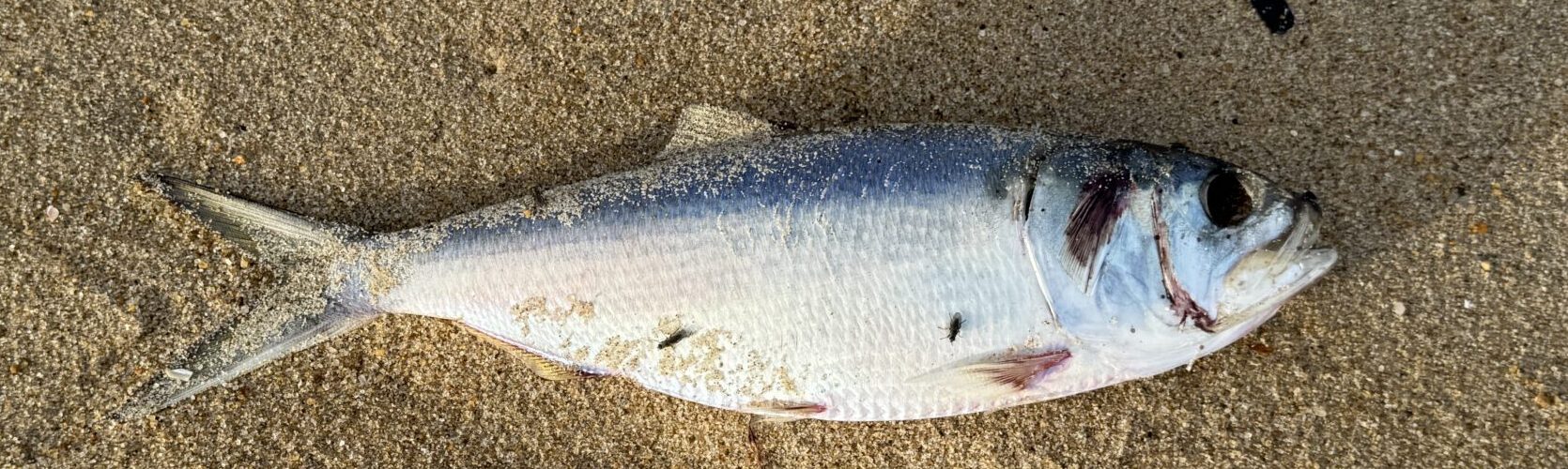
The beautiful, warmer than spring, day on the beach last week was by marred by the sad sight of hundreds of menhaden fish, still flip-flopping or lying dead, strewn up and down the beach, from Back Bay to the North End.
In turn, hundreds of gulls were the only happy campers. If they weren’t dining, the gulls floated close to shore, flew overhead or stood patiently waiting for the next meal to wash up.
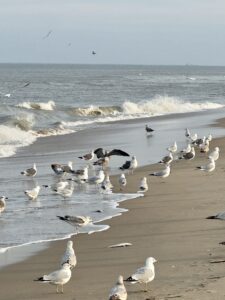
Menhaden kills occur off and on the beach in winter when there are sharp temperature changes, or commercial fishing boat nets break or overflow with thousands of fish that have migrated out of the Bay to the ocean to spawn.
For a plain little fish with only a jutting pugilist’s jaw to distinguish it outwardly, the menhaden has long been an important resident of Virginia waters and a topic of controversy. For decades the state of Virginia has grappled with regulating the fishery. Beloved by wildlife and industry, the menhaden takes little from our waters in return, dining only on plankton in rich Chesapeake Bay water.
Too oily and bony to be any good for humans to eat, not even in a fish stick, we every day folk know next to nothing about the little fish. Not so for bigger fish, such as rockfish, tuna, trout and mackerel and by our iconic Chesapeake Bay bird, the osprey, all of whom depend on menhaden as a food source.
The fish also is prized by industry for its oil that is used for everything, from animal feed to paint and cosmetics. The leftovers are ground into fertilizer. As far back as the settling of our country, it was said, that a menhaden was planted as fertilizer under each stalk of corn.
Therein lies the rub. Stocks of this plentiful fish are dwindling because it has so many uses. Many say the fishery must be regulated to provide wildlife and industry with what they need, as well as to better understand how the weather may affect their population.
The Virginia General Assembly has grappled with this push and pull for decades with little success. And that was true again this year, said Dylan Mason, LRNow’s Public Policy Manager.
“The only hope left is a $2 million budget item,“ he added, “that will establish a menhaden research fund for The Virginia Institute of Marine Science and the Virginia Marine Resources Commission to use in research.”
For a fish so little known and unregulated, menhaden could well be “The Most Important Fish in the Sea,” as it is called in a book by H. Bruce Franklin. Others say menhaden are the “breadbasket” for the East Coast.
And yet last week, the little fish were wasting away on the beach as the gulls ate from the breadbasket.