by Mary Reid Barrow
Though monarchs make a stunning long distance migration all the way down the East Coast and on to Mexico, other butterflies on the move may make you sit up and take notice this time of year too.
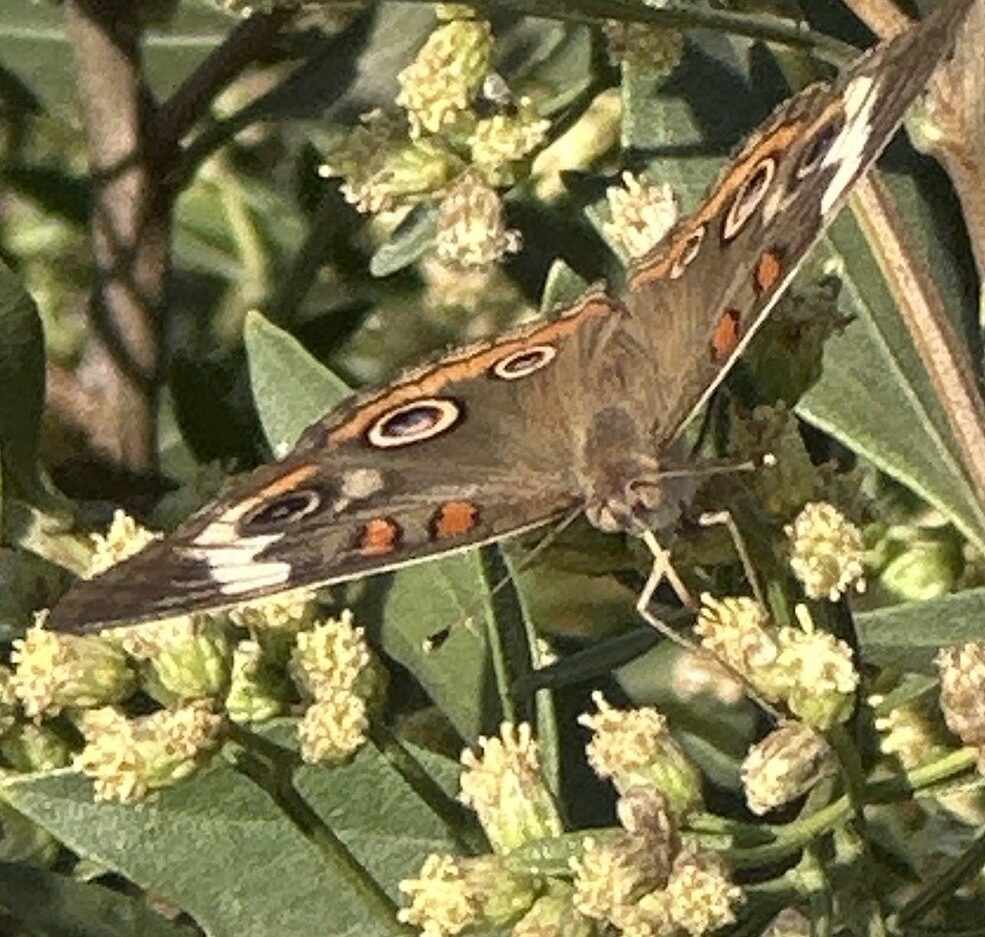
The saucy little buckeye butterfly, above, was among several buckeyes that Karen Harris saw nectaring on groundsel at Pleasure House Point when she participated in the Master Naturalist Bio Blitz recently.
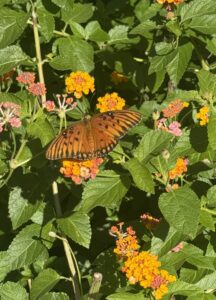
You can often see buckeyes in small groups moving south along the coast in fall. You also may see gulf fritillary butterflies, like this one. It stopped to nectar at the 87th Street Community Garden where Judi Knouf caught it with her camera.
Other butterflies such as red admirals, cloudless sulphurs and painted ladies, also move south this time of year, said Karen McCurdy, co-president of the Butterfly Society of Virginia. These butterflies’ travels are more like jaunts compared to the monarch’s long migration to Mexico, she explained.
Though some swallowtails and other butterflies may live through our winters in chrysalis, buckeyes and their ilk must move south to warmer states in order to survive. There they can continue to breed, go into chrysalis, hatch and carry on with their almost monthly life cycles.
Then, when the weather warms, like the snowbirds, the latest generation travels home again.
“They move to more southerly states,” Karen said. “And then they recolonize their northerly range each spring through summer.”
Migrating monarchs, on the other hand, are totally different. As Karen explained in last week’s Nature Notes, they are basically juveniles that lack a reproductive hormone and cannot mate.
That’s why they are able to live six to eight months in hibernation, rather than the average much shorter month or so life span of other butterflies.
“As the weather warms up in Mexico, the juveniles’ hormone is activated allowing them to mate as they head back up the East Coast,” Karen explained. “The females lay eggs, and the journey back home is left to the young.”
And who knows? I like to think that the monarchs meet up with the buckeyes, fritillaries and other short term travelers along the way for a spring homecoming!