by Mary Reid Barrow
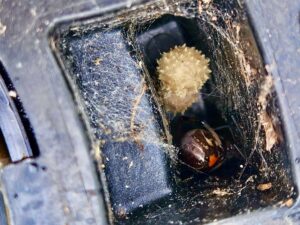
Tom Langley “nearly freaked” when he discovered what he thought was a black widow spider in a filter in his swimming pool in Little Neck.
“Yesterday, I removed the lid from our pool pump filter” he wrote. “There are a couple finger holes on the bottom of the lid and when I turned it over, the opening was covered by spider webs.
“I started to remove the webbing ,” he continued, “when I noticed a spider egg sac inside, and then I saw the spider and her bright red hourglass.”
That is when Tom nearly freaked.
He thought he had found a black widow spider because of the hour-glass shape on her belly.
“After calming down, I did my research and found that my spider was a brown widow spider, which I have never heard of,” Tom said.
Tom learned that brown widow spiders are an invasive species, initially from Africa.
He also learned that the distinctive spikey egg sac is a real giveaway because because the black widow’s egg sac is smooth and non-bumpy.
Both spiders nest in dark crevices, are dark in color and have hour-glass shapes on their bellies but there are some subtle differences.
The brown widow, as her implies, is browner looking and her hour-glass shape is more orange than red.
And, small comfort, though both spiders are venomous, the brown widow is less so.
These days brown widows have spread round the world to warm climates, local bug expert Maurice Cullen said. He sent a Virginia Master Naturalist map that shows its move up the East Coast.
They have traveled as far north as Washington, D.C., and beyond and have been seen in Norfolk and Richmond. Tom Langley needs no map to know there is one for sure in Virginia Beach!