by Mary Reid Barrow
Photos by Reese Lukei
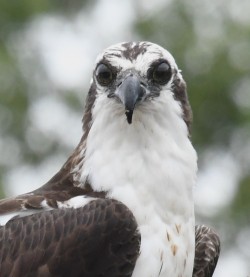
An adult male osprey with a nest on the Lynnhaven River may have a debilitating eye disease called glaucoma, which could be a first in the annals of osprey research, according to raptor expert Reese Lukei.
And that’s not the only interesting piece of information that Reese’s research has brought to light along the river this spring, or in the past for that matter.
Reese and researcher Keriann Spiewak at the Virginia Aquarium have been studying osprey nests on the river for several years. Their work, conducted by boat, is part of a larger study of the decline of osprey nests on the Chesapeake Bay conducted by Dr. Bryan Watts, director of the Center for Conservation Biology at William and Mary.
“So much has been going on,” Reese said.
He photographed the male osprey with bulging red eyes at its nest a couple of weeks ago. Then just this week Reese and Keriann also came across another osprey nest with a dead crow draped across what looked like a live nestling.
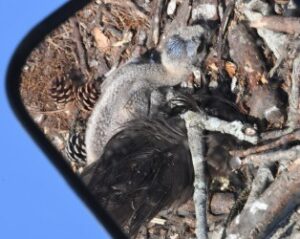
When Reese returned to the nest for a second look, the crow was gone, the chick was alive and the parents were at the nest. He said it was likely that the parents not only killed the crow and but also later removed it.
Reese said he has thought for years that crows were a primary cause of decline of osprey nestlings on the river. The lack of menhaden fish, a primary osprey food source, is the focus of the larger study at William and Mary.
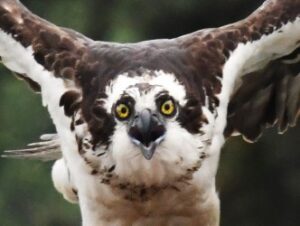
As for the osprey with the bulging red eyes, you can see that his eyes in the photo, above left, are remarkably different from the female’s yellow eyes on the right, though the red color doesn’t show up well in the photo.
Glaucoma, caused by a build-up of fluid in the eyes, does affect birds, according to a range of experts Reese contacted, but information on its occurrence in wild birds is rare to non-existent.
Yet, the osprey obviously could see well enough to fly back to its nest from its wintering grounds, perhaps as far away as South America, and it can see to bring fish to its young in the nest, he said.
“There are many unanswered questions,” Reese added.
And you may recall from a Nature Notes a couple of years ago, Reese and Keriann came up with the first documented evidence of a mink raiding an osprey nest in the Chesapeake Bay area, or anywhere for that matter. The mink conducting its raid was captured by a wildlife camera they had focused on a nest on the Lynnhaven River’s eastern branch.
Thanks to Reese and Keriann with the Aquarium, our osprey population is adding to the body of scientific information about these iconic birds. And there’s so much more to learn about why they thrive and why they don’t. Over time Reese has seen a huge fluctuation of osprey numbers on the Lynnhaven.
“I’ve seen the population go from zero nests in 1975 to 102 in 2019,” he said. “Now we’re down to 75 nests.”