
Note from Mary Reid Barrow: When biologist R. Harold Jones came across this carnivorous plant in a ditch in Sandbridge, he was truly surprised.
An Old Dominion University adjunct professor and owner of Sigma Environmental Management Inc., Harold has long been interested in carnivorous plants in the area, but he had never seen the beauty in his photo above before this summer.
The plant’s common name, swollen bladderwort, belies that beauty as does its Latin name, Utricularia inflata. Indeed, the bladderwort’s sunshine face also belies its underwater bladders that suck in and trap its dinner, primarily unwary mosquito larvae swimming by!
The discovery prompted Harold to write the following article for LRNow about the four species of carnivorous plants that can be found in this area:
Four species of carnivorous plants in Virginia Beach
Written by and photos by R. Harold Jones
The author has found four species of carnivorous plants, located on protected state and federal lands, in the City of Virginia Beach They include two species of bladderwort, the swollen bladderwort (U. inflata) and the slender bladderwort (U. subulate), and two species of sundews, roundleaf sundew (D. rotundifolia) and spoonleaf sundew (D. intermedia).
These highly specialized species are important components to the vegetational diversity of our region and should be left undisturbed in their natural settings.
Carnivorous plants are plants that derive some or most of their nutrients from trapping and consuming animals, mainly protozoans, typically insects and other arthropods.
They have adapted to grow in waterlogged sunny places where the soil is thin and/or poor in nutrients, especially nitrogen. They can be found in habitats such as acidic bogs, swales of various types and other small, non-flowing bodies of permanent or intermittently flooded or ponded water.
Virginia’s wetlands host three main groups of native carnivorous plants: pitcher plants (Sarracenia), sundews (Drosera), and bladderworts (Utricularia).
Pitcher plants such as the purple pitcher plant (Sarracenia purpurea), is native to areas like Caroline County, while the yellow pitcher plant (Sarracenia flava) is the showpiece in coastal regions.
Sundews consist of four native species that inhabit wet, sandy, or boggy and wet soils located in the coastal plain. They consist of roundleaf sundew (D. rotundifolia), spoonleaf sundew (D. intermedia), Pink sundew (D. capillaris) and the dwarf sundew (D. brevifolia) which grow in boggy mountain areas and coastal wetlands such as isolated swales. They capture their prey using sticky leaves to trap insects.
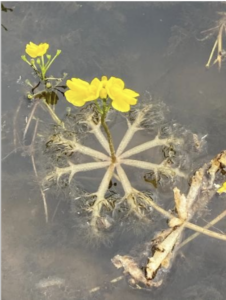
Bladderworts (Utricularia) is the largest genus of carnivorous plants in the state, with eleven species found in ponds, lakes, marshlands and closed, non-flowing ditches. The swollen bladderwort (Utricularia inflata), the humped bladderwort (U. gibba) and the slender bladderwort (U. subulate) are species most often encountered in the lower coastal plain. Two species of pitcher plants are rarely found in cut powerline right-of-ways below the James River.
Bladderworts are mostly aquatic or root-submerged plants with tiny, hollow suction traps (“bladders”) along their modified underwater stems. The bladders maintain a negative internal pressure like a vacuum. When tiny aquatic invertebrates or larvae brushes against the trigger hairs near the trap door, the bladder snaps open in milliseconds, sucking the prey inside with a rush of water, sealing the door, and releasing enzymes to digest the catch.
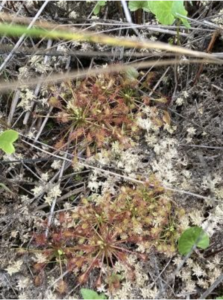
Sundews use a “flypaper” trapping method. Their leaves are covered in tiny, sensitive tentacles that secrete a glistening, sticky, dew-like glue. When an insect lands or crawls on the leaf, it gets stuck. The sundew then curls its tentacles (and sometimes the whole leaf) around the prey to pin it down, immediately releasing digestive enzymes to dissolve the soft body parts and absorb the nutrients.
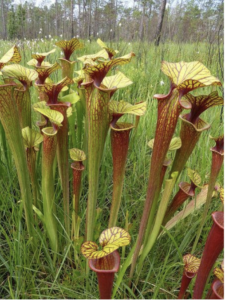
Leaves of the pitcher plant form deep, liquid-filled tubes (pitchers). They lure insects using bright colors, sweet nectar, and scent along the rim. The inside walls are slick with a waxy coating and feature downward-pointing hairs that stop prey from escaping by crawling back out. Prey fall into a pool of rainwater and digestive juices (aided by microorganisms and bacteria) where they drown and break down into a nutrient-rich slurry that the plant absorbs.