by Mary Reid Barrow
The smallest things in nature are having their heyday as summer wears on.
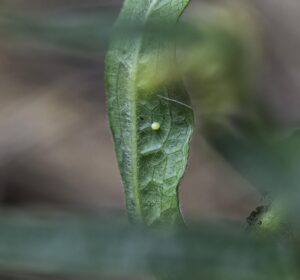
The tiniest I’ve seen recently is this pale yellow dot of an egg that a monarch butterfly laid on the underside of a milkweed plant leaf in my garden. The little egg’s journey to adulthood is not as perilous as it is for some insects because predators generally stay away from monarchs because of the toxins in their bodies from the milkweed plant itself.
So, if luck is with this little egg, it will hatch into a caterpillar that will eventually make a cocoon. From there, if luck stays with it, it will emerge as a full-fledged monarch and wing its way to Mexico this fall.
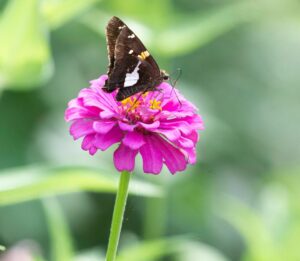

Gibbs Barrow took the close up of the egg and also of these small skipper butterflies, a silver spotted skipper, one of the few easily recognizable skippers and the little golden one, maybe a fiery skipper.
Skippers are flitting from flower to flower in my garden and were abundant at the Virginia Beach Middle School Butterfly Garden where LRNow held a Bug Walk last week.
Skippers are tiny little butterflies that you want to say are moths, but they don’t fly at night. You can identify skippers by the tips of their hooked antennae. They differ from butterfly antennae which have little balls on the tips and moth antennae which are feathery.
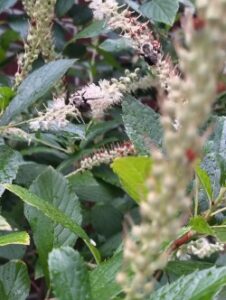
“Tucked in” was the way Nancy Gorry described a photo she took of this sleeping bumblebee on her clethra. Somehow the conversation ranged to sleeping bees on the Bug Walk and Terri Gorman, LRNow’s Pearl Home Manager, later sent this photo of one sleeping in a swamp sunflower in her garden.
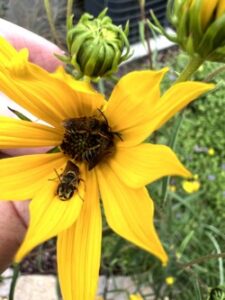
As far as sleeping bees go, I learned that all honeybees return to the hive for the night, female bumblebees return to their nests to sleep, and males tuck into a flower. I, for one, think that last is best!
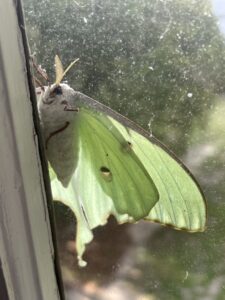
Speaking of tiny things hatching and sleeping and of feathery antenna, this beautiful luna moth spent the day sleeping on my next door neighbor Jenny Johnson’s window. She probably hatched from one of the persimmon trees or the sweet gum along my driveway, both are luna moth host trees, and was waiting for her prince to come. To mate is her only goal in life. She has no mouth parts, doesn’t eat, of course, and doesn’t live much longer than a week.
Male and female luna moths are both elegant but, as is often the way in the animal world, the males are flashier. The female’s antennae, though feathery, are shorter and the male’s feathery antennae are longer and flowy. Males also have longer showier tails.
On the other hand, the female has the practical edge, as is often the way too–an eye spot on each wing probably to direct a predator bird to her wings, not her body.